Drifting a BMW E36 328i in Buenos Aires: The Car, Mods and Track
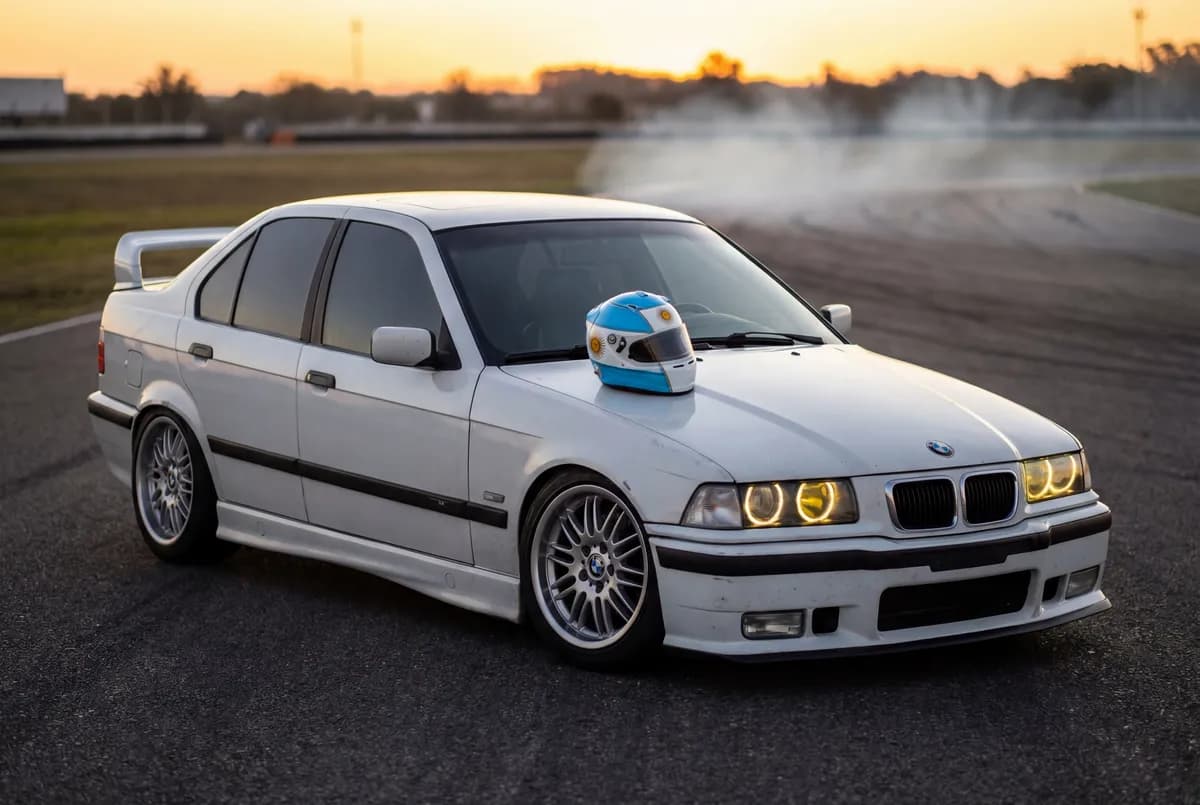
Why the BMW E36 Is the Ultimate Drift Platform
Ask any drift driver in the world what the ideal platform is for serious drifting and the most common answer will be: BMW E36. It is not a coincidence. The E36 is arguably the most popular chassis in global drift culture and there are concrete reasons for that.
The BMW E36 was manufactured between 1990 and 2000. It is rear-wheel drive, has near 50/50 front-to-rear weight distribution, an inline-6 engine that delivers power progressively and a lightweight platform that responds well to modification. It is the perfect car for learning, for competing and — in our case — for giving passengers a drift experience they will never forget.
The Engine: BMW M52 2.8-Litre Inline-6
At the heart of our drift car is the M52B28 — a 2.8-litre inline-6 that BMW fitted in the 328i model. This engine produces roughly 190 HP from the factory, but the important thing is not the peak power number but how that power is delivered.
BMW inline-6 engines are famous for their smoothness, throttle response and linear torque delivery. In drifting, this is critical. The driver needs to modulate power with precision — too much too suddenly and the car spins, too little and it loses angle. The M52 delivers exactly that: progressive power the driver can control with their right foot like a musical instrument.
M52 engines are also legendarily reliable. These engines can exceed 300,000 km on basic maintenance. For an operation like ours where the car is under constant track stress, reliability is everything.
The Welded Diff: The Key to Drifting
If there is one single modification that defines a drift car, it is the welded differential. In a normal road car, the differential allows the rear wheels to spin at different speeds — necessary for turning on the street without chirping the tyres. But in drifting, this is exactly what you do NOT want.
With a welded diff, both rear wheels always spin at the same speed. When the driver breaks traction (whether through throttle, handbrake or a combination), both wheels slide in unison. The result is a sustained, controllable and predictable drift.
Without a welded diff, the car tends to regain traction unpredictably because one wheel grips while the other slips. Drift becomes inconsistent and risky. Our BMW has a welded differential — it is one of the first modifications made to any serious drift car.
Suspension: Adjustable Coilovers Built for Drift
A drift car's suspension is radically different from a road car's. Our E36 runs height and damping adjustable coilovers — we can fine-tune the ride height and suspension stiffness based on track conditions.
For drifting, the suspension is set firmer than a street car. This reduces lateral weight transfer and makes transitions between corners quicker and more predictable. The car is also lowered to improve the centre of gravity.
Another critical adjustment is steering geometry. Our car has an extended angle kit that allows the driver to turn the wheels beyond the stock BMW limit. This is what enables the car to maintain extreme drift angles — when you see the car going nearly fully sideways, it is thanks to this kit.
Interior: Safety First, Weight Second
If you look inside our BMW E36, it looks nothing like a road car. Everything non-essential has been removed to cut weight and make room for safety equipment:
- Roll cage: A steel tube structure welded directly to the car's chassis. If the car were to roll (extremely unlikely on a flat circuit), the cage protects the occupants. Mandatory in any drift competition
- Racing seats: Fixed fibreglass seats that hug the body. Unlike regular car seats, these do not move, do not recline and hold the occupant perfectly in position even under extreme lateral forces
- 4-point harnesses: Two straps over the shoulders and two at the waist with a central buckle. Individually adjusted for each passenger. The harness holds you so firmly you literally cannot move from the seat — and that is exactly the point
- Onboard fire extinguisher: Mounted within the driver's reach. Mandatory in competition
- Electrical cut-off: An exterior switch that kills all electrical power to the car, used in emergencies to shut off the engine instantly
There is no carpet, no door cards, no stereo, no air conditioning. All removed to save weight. Every kilogram removed is one less kilogram the suspension, brakes and engine need to handle.
Why the E36 and Not Another Car
We could have chosen many cars for drifting. The Nissan 240SX/Silvia is popular. The Toyota 86 is too. Some people drift Mustangs. But the E36 has a unique combination of attributes:
- Affordable parts: BMW sold millions of E36s. Parts are abundant and relatively cheap, even in Argentina
- Aftermarket support: An entire industry of drift-specific parts exists for the E36 — angle kits, differentials, suspension arms. All available
- Reliable engine: The M52 simply does not break. For an operation that uses the car every weekend, this is critical
- Ideal weight: The E36 weighs around 1,300 kg without interior — light enough to be agile but heavy enough to be stable
- Weight distribution: Near 50/50 front-to-rear. This makes the car balanced and predictable in drift
- Aesthetics: Let us be honest, the E36 is a good-looking car. Passengers get excited when they see a 90s BMW built for track use
The Track Where We Operate
Our BMW E36 operates at a closed racetrack in the western area of Greater Buenos Aires. It is a private circuit with well-maintained asphalt, generous run-off areas and zero traffic. The layout features a mix of straights (where the car accelerates past 100 km/h) and corners of varying radius (where the driver initiates and sustains the drift).
We do not share the track with other vehicles during Drift Taxi sessions. When a passenger is in the car, the track is exclusively theirs. This is fundamental for safety and allows the driver to use the full width of the circuit without restriction.
Frequently Asked Questions
Why use a BMW E36 and not a newer car?
Because the E36 is the most proven drift platform in the world. It is lightweight, rear-wheel drive, has a reliable inline-6 engine, affordable parts and a massive drift community developing purpose-built components. A newer car would be more expensive to maintain and modify without offering real advantages for drifting.
Is the car truly competition-prepared?
Yes. It has a roll cage, fixed racing seats, harnesses, welded differential, adjustable suspension and an angle kit. It is the same type of build used in drift championships. The only difference is that we keep the passenger seat for riders.
What are the exact modifications?
The main ones: welded differential, adjustable coilovers, extended steering angle kit, roll cage, racing seats, 4-point harnesses, fire extinguisher, electrical cut-off, stripped interior. The engine remains naturally aspirated (no turbo) because the linear power delivery of the M52 is ideal for drifting with passengers.
What engine does it have and how much power?
BMW M52B28 2.8-litre inline-6, naturally aspirated. Approximately 190 HP factory rated. For drifting with passengers you do not need more power — what you need is control, and this engine provides plenty.
Want to experience this car in person? Read about what the full experience is like or go ahead and book your session. You can also learn how the E36 is used for learning to drift or for track days in Buenos Aires.
Can I film with my phone inside the car?
We do not recommend holding your phone during drift for safety. But the onboard GoPro captures everything and we send you the video the same day.
Is the BMW E36 safe for passengers?
Absolutely. The car has a certified roll cage, racing seats, 4-point harnesses and onboard fire extinguisher. It meets competition safety standards.